
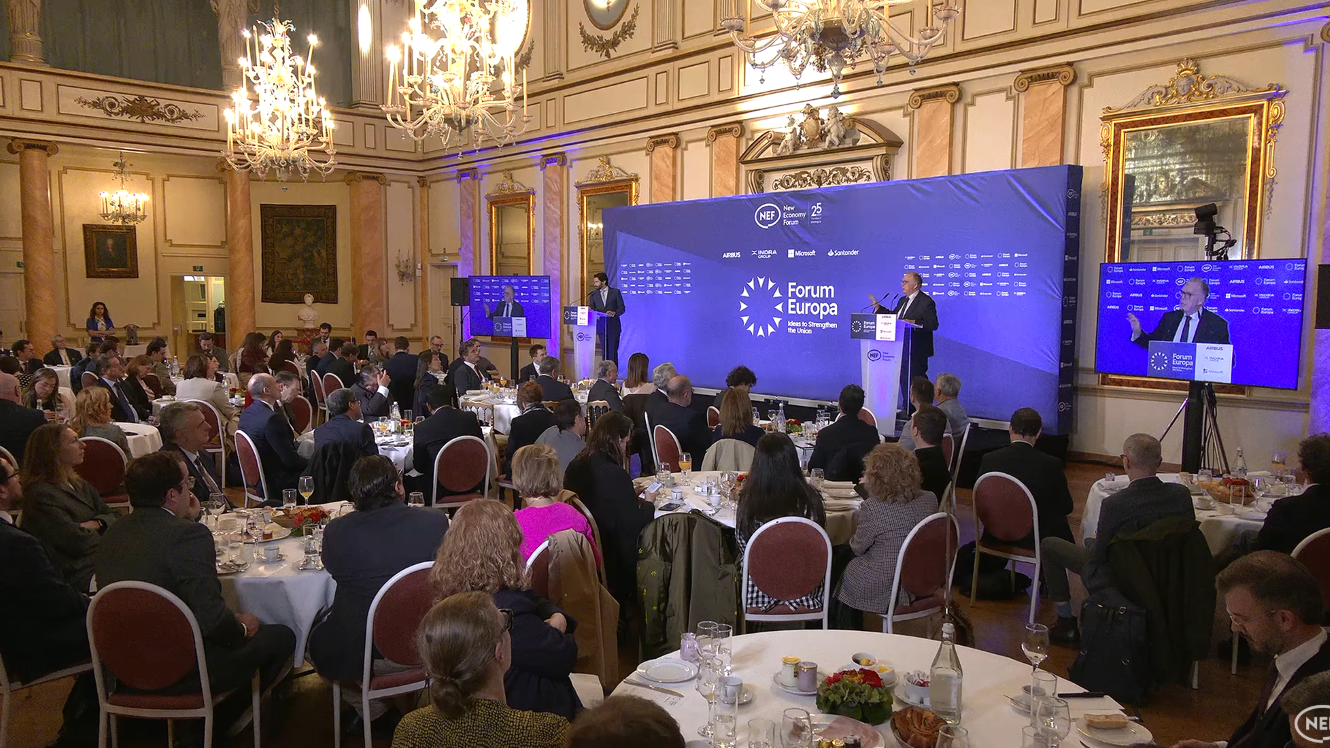
The President of the European Economic and Social Committee (EESC), Séamus Boland, commented on Tuesday at the Forum Europa in Brussels that “Europe could have come together more to support Spain” with its migration issues over the summer –referring to the mass influx of migrants into Ceuta– and warned that “this situation should not be repeated”.
“Spain was dealing with the problem at its own borders, something it perhaps did not expect. Be that as it may, that is beside the point. The question is: did Europe rally round Spain? No, it did not. Therefore, Europe needs greater cohesion on migration”, he said at a breakfast briefing organised by New Economy Forum in the EU capital.
Boland pointed out that migratory pressures affect other countries, such as France and Italy, and acknowledged that “there are critical points at the borders”, which require “Europe to share the burden”.
However, he noted a “lack of unity” amongst governments on this issue and called on the authorities to respond with a more coherent policy based on economic facts, something which, in his view, is not currently being done.
The EESC President lamented that European governments have “lost the communications battle” and that social media has imposed its own narrative on immigration. Boland denied that migrants are taking homes or jobs away from the local population, as is widely reported on social media, and he emphasised that it is foreign nationals who enable certain jobs to survive in many countries.
“We must understand that we are no longer dealing with facts and figures”, he said regarding the anti-immigration messages spreading on social media. To combat these ideas, he called for the involvement of civil society to manage immigration in collaboration with local communities and regions through preparedness plans, and warned that this is the only way to integrate thousands of people into a community, regardless of the country in question.
Boland acknowledged that immigrants’ entry into the labour market often takes place through precarious, poorly paid jobs and, at times, through the informal economy without social security contributions being made in their home countries. “If you can find someone to work for half the wage, you will dispense with those who earn a fair wage. That is a real problem”, he warned.
Social media plays “an excessive role” in such cases, as it exploits these situations to “magnify and exaggerate” them. To prevent this, the EESC President encouraged businesses to act “correctly” and called for national legislation to guarantee the legal recruitment of immigrants.
Boland referred to “cooperation mechanisms” which would ensure that, when a migrant arrives in a country, their entry is managed “through a systematic approach involving all the relevant parties”.
The EESC President concluded that the solution “lies in more legislation and more regulation”, in order to prevent informal situations and act in the interests of society and of the migrants themselves.
THANKS TO THE SPONSORSHIP OF